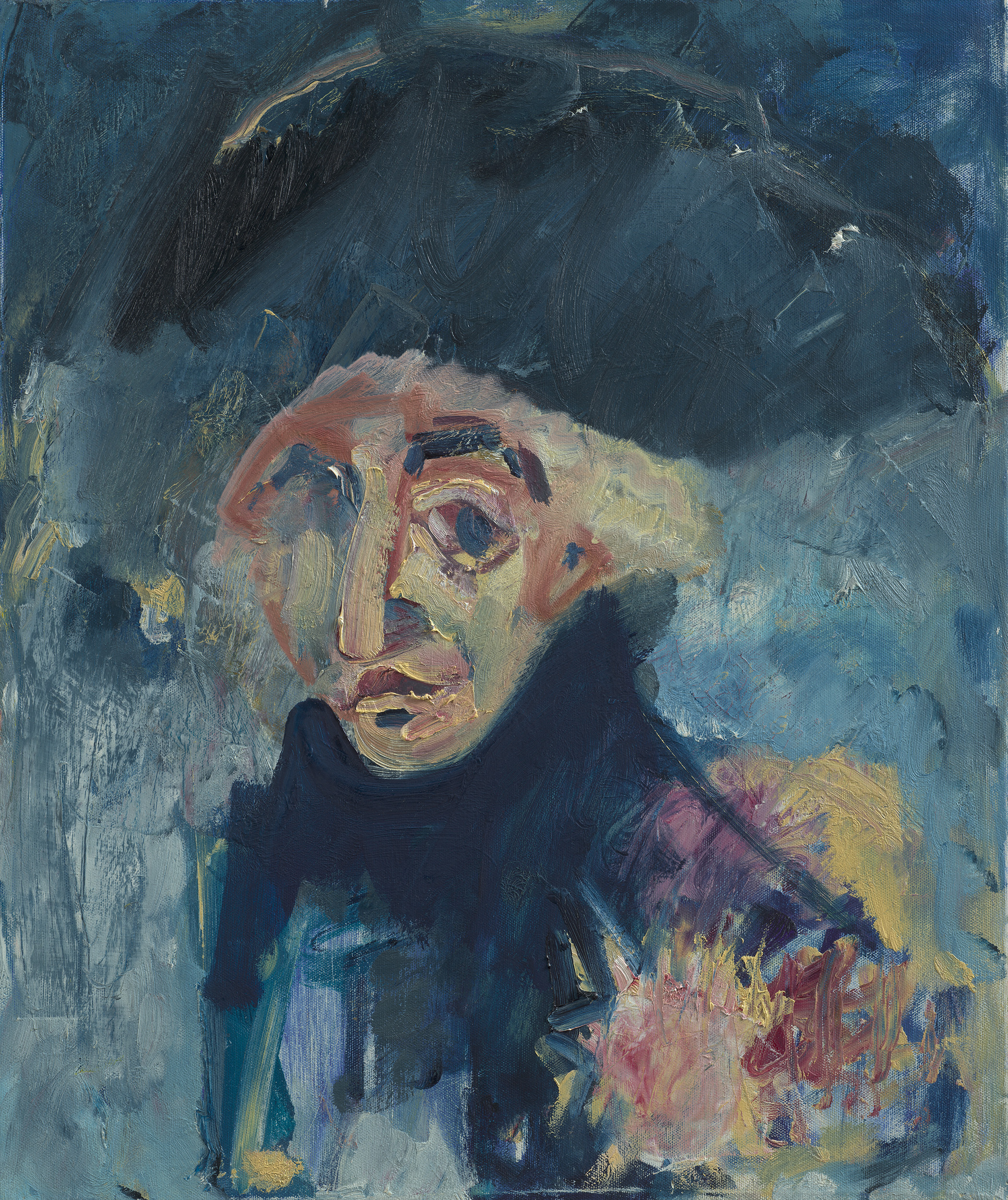
August 1st is the anniversary of the beginning of the 1798 Battle of the Nile. This was the first of Nelson’s three major engagements (the other two being Copenhagen and Trafalgar). After searching for Napoleon’s ships for two months, Nelson had found them lolling at the mouth of The Nile. By this point, Napoleon and his soldiers were already inland, fighting against the cinematic backdrop of the pyramids.
Those sailors left to man the French fleet in the Egyptian port believed themselves safe from any attack. It would be madness, they reasoned, for the British fleet to dare to get in close to them. After two months chasing the French tail, however, Nelson and his men were mad enough to try. Nelson drove the British ships straight into the unknown waters of the bay and smashed the unprepared French ships to pieces.
It was a mauling without comparison. It secured Nelson’s place in history. The scale of the victory stunned the world. The Royal Navy had lost none of its warships; France had lost thirteen.
The incident most frequently depicted in artwork of the battle is the sinking of the towering French ship, L’ Orient. Here is the story of its destruction. It is an extract from The Lamented Hero, my upcoming biography of Nelson.
We join the story deep into the first night of the battle...
The carnage was visceral. Cannon fire lit up the night sky in bursts, their flashes revealing tableaus of atrocities. Across the decks – amidst the split masts and fallen tangles of sails – men folded over, vomiting, crying, screaming, loading, firing, bleeding, ducking, dying. One sailor’s entire stomach was blown out and flew across his ship. It splatted on a post and stuck to it like a pancake. (Later, when the ship’s butcher tried peeling it off with a nail, he remarked, ‘Who the devil would have thought the fellow’s paunch would have stuck so? I’m damned if I don’t think it’s glued on’.) One French captain had his right arm ripped straight off by a bullet, then his left. Minutes later, a cannon sliced through both of his legs. His sailors shoved his torso in a barrel, from which the man continued to bark orders above the thunder of gunfire until he ran out of blood.
Nelson thought himself a dead man, too.
‘I am killed,’ he cried, as a fold of torn skin flapped over his one good eye, causing blood to rush down his face. He’d mistaken the ensuing darkness for death. He was hurried to the doctor below the Vanguard’s deck. As at Tenerife (see here), he demanded that he didn’t jump the queue to the medical table:
‘I will take my turn with my brave fellows.’
(After the battle, Nelson refused to have his name on the official list of casualties. His injuries would have justified inclusion. His surgeon noted that his cranium had been ‘bared for more than an inch’.)
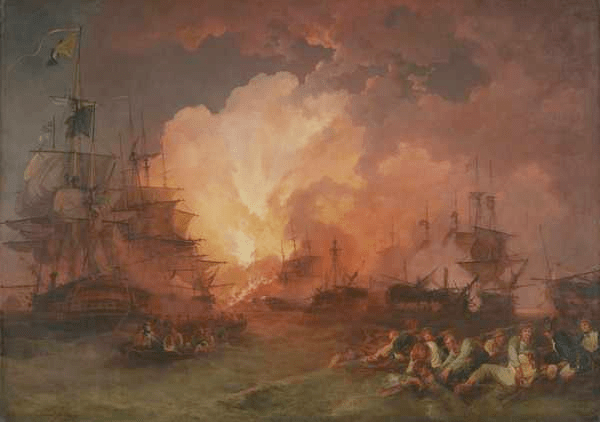
Whilst queueing in the surgeons’ quarters, a rumour circulated. It caused Horatio to ignore the chunky flap of skin hanging over his eye and rush up to the top deck.
Even with his compromised vision, the sight was unmissable. Across the waves, under the chalky white Egypt moon, the biggest French warship of them all, L’ Orient, was aflame.
Fire was checkmate for wooden ships. You could shoot cannons at a warship as much as you liked, but for all the holes they might punch, a warship almost never sunk without burning first. Nelson watched as the flames consumed L’ Orient, knowing that news of its ensuing sinking would race across Europe.
That the L’ Orient burned so fearsomely and so fast is possibly due to it being struck with Greek Fire, a controversial and ungentlemanly method of attack (but one which, it’s quite likely, the French had access to, too). The alleged British use of Greek Fire would remain a point of debate evermore. What was undoubtedly true was that the L’ Orient had paint cans on its deck, and possibly phosphorous, rendering it a 5,000 tonne tinderbox.
The L’ Orient was under the watch of Vice-Admiral Brueys: the man Napoleon had left in charge of his fleet. Brueys met a brave end, seen flopping about valiantly on L’ Orient‘s deck having lost his legs. Like his comrade from the top of the piece, he then shouted orders from a chair, before being split in two by a random rake of gunfire.
Given its name by Napoleon – who didn’t like its original royalist monicker of Le Dauphin Royal – the L’ Orient was said to contain around £600,000 of currency. This was money pilfered from Rome and Switzerland for bartering on arrival in Napoleon’s ultimate target, India. It would all be lost.
The grand ship drifted aimlessly southwards, burning, away from the line. As it was still tethered to other ships in the bay, its heat was a hazard for anything dragged into its vicinity. The ferocity of its flames warmed even the faces of the growing crowd of Egyptian onlookers on the shore.
Further down the line, other French ships panicked in the chaos. The bravado of the British attack had caught them cold. Some fired at each other in the darkness, thinking they were facing British ships. As the L’ Orient‘s flames licked ever higher in the night sky, the firing between ships stopped momentarily, as the men on both sides awaited the explosion.
There were a thousand fellow sailors on the L’ Orient. As its beams cracked and split, smoke poured moon-wards in ever-vaster volcanic plumes. The men’s screams cut across the water. Some were seen diving off the decks.
Then came the unmistakable whizz and wheezing of explosives. The heat had reached the gunpowder store.
Silence. For half a second.
Boom.

People heard the explosion twenty miles away. Some saw it, too: a thin, red arrow shooting up against the black horizon.
For those much closer to the action, even the protective bands wrapped tightly around their heads didn’t stop their eardrums from splitting. The debris proved every bit as dangerous as cannon fire. Body parts, rigging, splinters of iron and wood, rained down on everybody and everything. A three-ton cannon was tossed 250 yards.
There then followed an unprecedented silence, a ceasefire of a length disputed by all involved (likely to be around the five-minute mark). Nelson ordered small boats to go out and rescue enemy sailors in the water. All that remained of their palatial, floating titan was its hollow shell of windowless wooden frames, left to slowly drown.
This momentary ceasefire was replaced, wrote an English lieutenant, by the ‘roaring of the guns, the crashing of the masts and the shrieks of the wounded and the jargon of the surrendering French’.
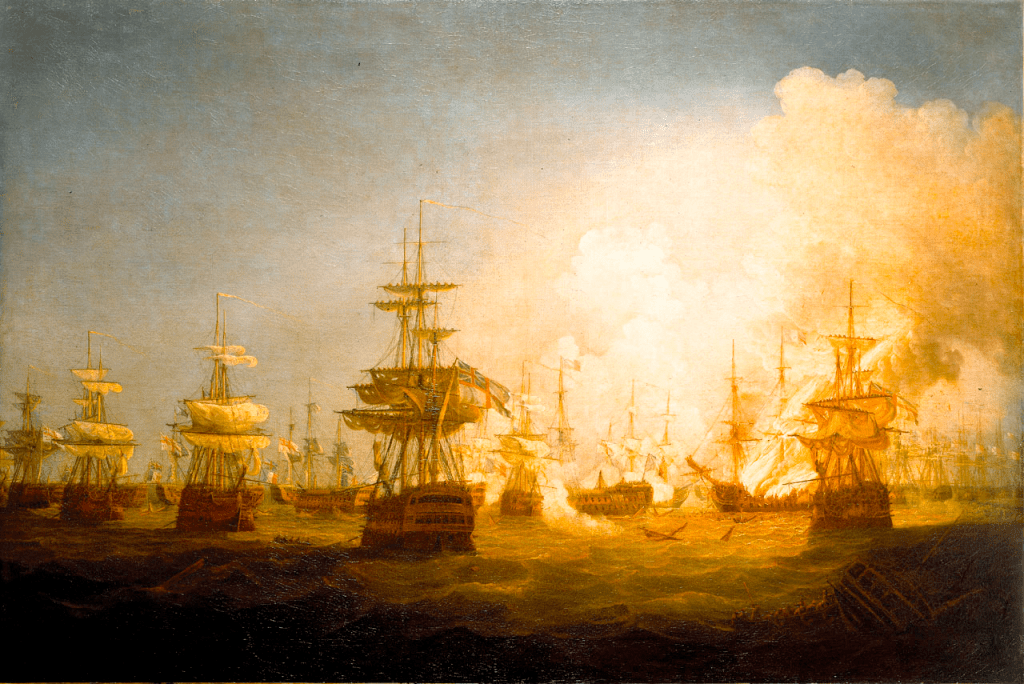
‘No incident produced in war by human means has ever equalled the sublimity of this coinstantaneous pause and all its circumstances,’ wrote Nelson biographer, Herbert Marsh, about the L’ Orient‘s explosion ten years later (possibly having recently purchased a new dictionary full of fancy words like coinstantaneous).
The ship’s demise and the ensuing victory at the Nile marked the true beginning of the Nelson legend. The boldness and scale of it – and the desperate need for it – set Nelson on a path from which there was no return. From now on, he would be expected to repel any threat at sea.
Only seventy or so of L’ Oreint‘s crew had jumped into the Nile by the time the ship exploded. Its brave Vice-Admiral had died, legless. But it was the actions of L’ Orient’s commander, Casabianca, that were best remembered. His story was romanticised in an 1826 poem recited by heart in Victorian schools. Casabianca had told his ten-year-old son to wait for him on the burning deck and not move until ordered. The boy had obliged, refusing to move even as the flames engulfed him.
The poem tapped into the Victorians’ love of heroism and sentimentality. More significantly, it represented the importance of following orders, even into the most harrowing of deaths. The poem has somewhat faded into obscurity. A little like the L’ Orient, and a little like the battle itself.
Share this post and subscribe for regular Nelson updates. Let’s keep Nelson’s story alive.
 Nelson The Sailor