Having ploughed my way through countless books about Nelson and Georgian England, I thought you might be interested in seeing what some of my favourites are. Here are ten of the best (in no particular order):
Nelson – Carola Oman (1946) – I know I said these are in ‘no particular order’, but this is probably my favourite biography. Published just after the second world war, it is one of the few Nelson books which stops and smells the roses. By which, I mean it has vivid descriptions of locations and gives a visual sense of the Georgian era. Oman is particularly good when writing about Nelson’s home life in Norfolk. I felt I was being gently guided by the author through Nelson’s story. That is the highest compliment that can be given to any historical writer.
The Story of Nelson – L Du Garde Peach (1957) – Is it silly to include a Ladybird book in this list? I don’t care. The short, simple paragraphs and painterly images have, I suspect, provided a starting place for numerous Nelson fans over the years. Aside from its aesthetic beauty, it has one of the great opening lines to any history book ever: ‘Two hundred years ago a little boy, called Horatio Nelson, was born in the County of Norfolk, and grew up to be the greatest fighting sailor England has ever known’. Who wouldn’t want to read on after that?

Nelson’s Women – Tom Pocock (1999) – All Nelson fans will recognise Mr Pocock of one of the masters of his subject. Pocock’s 1987 biography of Nelson is many people’s favourite, but I found this little tome on the women in his life both enlightening on the era and on Nelson himself. My favourite moment of the whole book was when Pocock informs us that Nelson’s daughter, Horatia, in her old age, used to go upstairs during thunderstorms and look out of the window in awe (insinuating that she might have inherited an attraction to explosive noises from her father). This book deserves a lot more love than it has received.
Horatia Nelson – Winifred Gerin (1970) – Whilst we’re on the subject of Horatia… Winifred Gerin’s biography offered a much-needed focus on the life of Nelson’s secret daughter. This book will be of particular interest to those familiar with Norfolk, as it has lots of nice details about 19th century life and society in the county. Perhaps more than any book on this list, this is the one that has haunted me most. Whenever I visit Burnham and the surrounding villages and towns, I always try to imagine the orphaned Horatia’s footsteps.
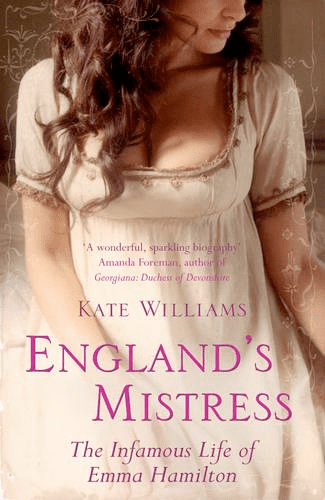
England’s Mistress – Kate Williams (2006) – An essential and fair insight into the mysterious life of Nelson’s mistress, Emma Hamilton. It rightfully frames Emma Hamilton’s childhood forays on the backstreets of London in as disturbing a light as is necessary. By revealing the sordid lifestyle into which she was prey, it makes her ascent into ‘Lady Hamilton’ seem all the more remarkable. And, of course, through Hamilton’s story we get a sharper image of Nelson. In fact, you may be noticing a trend with these books by now: it seems the most insightful revelations about Nelson come in books about those who knew him, rather than in books directly about him. My edition of England’s Mistress was let down by a hideously raunchy front cover which not only typifies how publishers expect the public to still feel about Emma Hamilton but also gave Williams’ brilliant book the look of a Jilly Cooper novel.
Trafalgar – Roy Adkins (2004) – I love Roy Adkins’ books. He is always clear and concise, never using overly flowery language or technical terminology. There are dozens of books specifically about Trafalgar but this one stands out for its building of tension and its description of the storm that battered the victorious ships on their journey home. As with all Roy Adkins books, this is an easy read and a must-read.
In These Times – Jenny Uglow (2014) – A thrilling account of daily life in Britain during the threat of French invasion. No other book better conveys the fear which normal people suffered at the thought of losing their country. Some really great extracts from private diaries and letters, coupled with a clear overview of the political tensions in London and abroad. This book is a perfect reminder of why Nelson was so loved. He was the nation’s last line of defence. For several years, he carried a desperate, frightened England on his shoulders. We mustn’t lose sight of that.
The Years of Endurance 1793 to 1802 – Arthur Bryant (1942) – Similar to Uglow’s book but with a focus squarely on parliament and key historical figures of the age. Bryant wrote a good biography of Nelson, but Years of Endurance is more valuable because of the magnifying glass it places over this period of anxiety. I have a soft spot for it also, I think, because it was published in 1942, when Nelson and his navy were a valuable propaganda tool for a Britain on the ropes.

English Society In The Eighteenth Century – Roy Porter (1982) – A riot of a history book. Porter has a lovely non-judgmental tone but his choice of facts and quotes always leads you to believe he is writing with a grin. There is plenty of scandal in here, but it’s at its best when giving a sense of day-to-day life in Nelson’s England. I have such admiration for this book because it does what I am aiming to: synthesising existing writing and complex information into something accessible.
A Dream of Glory & The Sword of Albion – John Sugden (2004) – These are inarguably the two definitive Nelson biographies. They are the biographical equivalent of a DVD box-set, with hours of extra features and director’s commentaries. Absolutely every aspect of Nelson’s life is covered. Published amongst the glut of Nelson biographies released to coincide with the 2005 Trafalgar celebrations, they are so detailed that you wonder whether Mr Sugden is a secret time-traveller who followed Nelson around taking notes. As you might expect of something so thorough, the combined pages of these two books totals around the 2000 mark. Certainly not one for beginners, but it would be criminal to leave Sugden’s work off this list.
There we are, then. Ten great books on Nelson and his times. Perhaps there are a few surprises in there – and a few notable omissions (not least Russell Grenfell’s Nelson The Sailor, whose title inspired the name of this blog). Maybe I’ll do a list of the ten worst one day… I might include my own book in it.

